
German Language A1 to C2 Levels: Everything You Need to Know About





Learning German opens countless doors for students and professionals considering education, work, or travel in Germany. But the first step is understanding how language proficiency is measured. The Common European Framework of Reference for Languages (CEFR) is the gold standard for measuring language achievements by assessing and describing language skills.
It classifies proficiency into six levels, such as A1 (Beginners), A2 (Basic knowledge), B1 (Advanced), B2 (Independent language use), C1 (Specialist language skills), and C2 (Almost native speaker), that cover the journey from beginner to expert. In this blog, let’s go through each level of German, outlining what learners in Kerala should know about the syllabus, grammar, vocabulary, and exam expectations at every stage.
Understanding the German Language Levels (A1-C2)
Language learning follows a structured path, and the CEFR is designed to make that structured path clear. As a result, learners, educators, and employers can more accurately assess German language communication skills. Each level represents a specific stage of development.
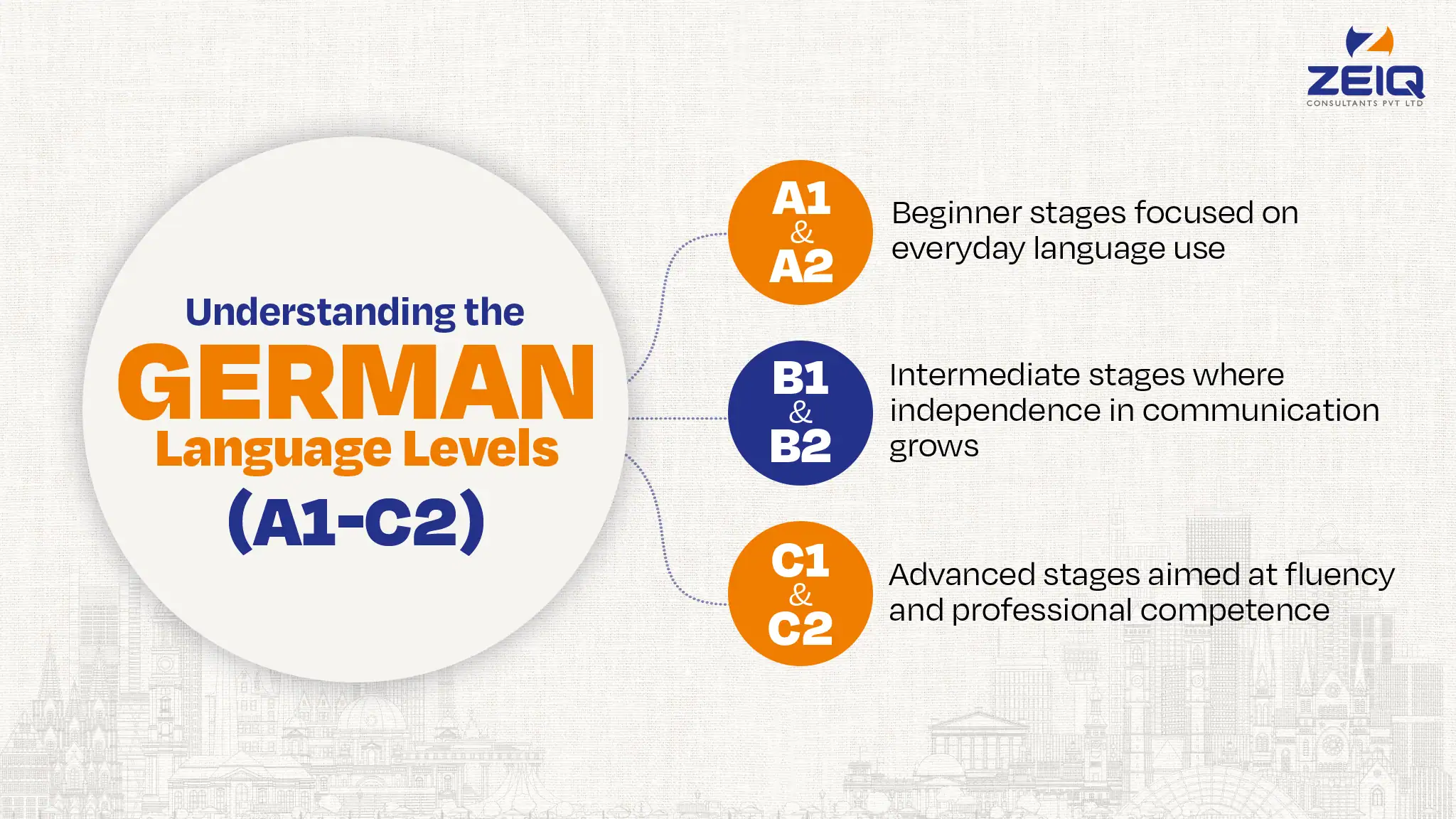
- A1 & A2: Beginner stages focused on everyday language use.
- B1 & B2: Intermediate stages where independence in communication grows.
- C1 & C2: Advanced stages aimed at fluency and professional competence.
Now that you know how each category is defined, let’s look at what every level of German learning actually involves, starting with A1 level German, the beginner stage. It allows you to set realistic goals and track your progress as you continue your German learning journey.
A1 Level German – Beginner Stage
The A1 level is designed for absolute beginners with little or no prior German experience. At this stage, you will begin building your vocabulary and learning common phrases. Your vocabulary includes around 500-800 basic words used in daily communication.
Learning Goals
At this level, you can understand and use everyday expressions related to immediate needs. You can introduce yourself, ask questions about personal details, and participate in short, simple conversations such as ordering food, greeting people, or asking for directions.
Syllabus Overview
- Greetings and introductions
- Numbers, days, and basic time expressions
- Talking about family, work, and daily activities
- Shopping and dining vocabulary
- Asking for and giving directions
Grammar Overview
At the German language A1 level, you learn to use the present tense of both regular and irregular verbs. You also begin understanding sentence order, especially the verb-second rule. Learners become familiar with articles and noun genders (der, die, das), simple negation with nicht and kein, and the use of personal pronouns and basic question forms correctly.
Exam Focus
The German A1 level exam checks your ability to handle basic listening, reading, writing, and speaking tasks. You may be asked to fill in simple forms, introduce yourself, or respond to common questions.
A2 Level German – Elementary Stage
A2 suits learners who already know basic German and want to communicate more confidently in everyday situations.
Learning Goals
At A2, you can handle short social exchanges, talk about your background, family, and surroundings, and manage routine tasks requiring direct communication. While your sentences may still be short, your understanding of common contexts improves.
Syllabus Overview
- Talking about hobbies, work, and health
- Shopping and travel-related situations
- Expressing preferences and opinions
- Describing personal experiences in simple sentences
- Writing short emails or notes
Grammar Overview
At the A2 level, you start using the simple past tense (Perfekt) to talk about experiences. You also learn reflexive verbs and how to use prepositions of time and place correctly. Comparative and superlative forms help you describe things more precisely, while modal verbs such as können, müssen, and dürfen are introduced for expressing ability, necessity, and permission.
Exam Focus
The A2 German exam includes short listening passages, simple readings, and spoken interactions about familiar situations such as shopping, transportation, or leisure.
B1 Level German – Intermediate Stage
B1 marks your transition to independent communication. You can comprehend the main points of clear speech and written texts on familiar topics like work, school, and travel.
Learning Goals
You can describe experiences, express opinions, and connect ideas in simple text. You can also manage conversations in German-speaking environments without much help.
Syllabus Overview
- Describing experiences, events, and aspirations
- Discussing current issues like the environment and culture
- Handling work or study-related conversations
- Writing short essays or letters
- Understanding TV shows or news with familiar content
Grammar Topics
At the German language B1 level, learners begin using subordinate clauses with words like weil, dass, and wenn to form more complex sentences. You also learn how to build relative clauses and correctly use modal verbs in the past tense. Grammar at this stage includes mastering adjective endings and improving sentence structure for clarity and flow.
Exam Focus
The B1 German exam evaluates understanding of everyday topics, writing structured texts, and speaking clearly about personal experiences. This level is often required for residence or work permits in Germany.
B2 Level German – Upper Intermediate Stage
B2 shows you have a strong command of the language, making you capable of discussing both concrete and abstract subjects and of interacting comfortably with native speakers. By this stage, your vocabulary exceeds 3,000 words and covers academic and professional contexts.
Learning Goals
At this stage, you can understand complex texts, follow detailed discussions, and express your ideas fluently in a wide range of situations you are in. Your vocabulary expands to include academic and professional terms.
Syllabus Overview
- Reading and analyzing news articles
- Engaging in debates and expressing viewpoints
- Writing detailed essays or reports
- Discussing cultural, social, and technical topics
- Understanding idiomatic expressions
Grammar Overview
The B2 level introduces more advanced grammatical structures such as the passive voice and indirect speech. You also learn the subjunctive mood (Konjunktiv II) for hypothetical or polite expressions. This level covers advanced connectors and conjunctions for linking ideas smoothly and explores word formation and nominalization for formal writing.
Exam Focus
The German B2 exam measures understanding of extended texts, spontaneous speaking, and the ability to write organized, detailed content. This level is often required for university admissions or professional work in Germany.
C1 Level German – Advanced Stage
C1 indicates strong academic and professional fluency. At this level, students can use German effectively and naturally in both formal and informal contexts.
Learning Goals
You can read long, complex texts, understand implicit meaning, and express yourself fluently. You can produce well-organized, detailed writing and participate actively in discussions or presentations.
Syllabus Overview
- Academic vocabulary and essay writing
- Analyzing complex arguments
- Writing professional reports
- Understanding advanced reading materials
- Formal communication and presentation skills
Grammar Overview
At the C1 level, you refine your use of grammar to sound more natural and professional. You’ll practice nominalization and master complex sentence patterns that make your writing more academic. Learners also work on subtle distinctions in modal verbs, as well as advanced passive and conditional forms for precise communication.
Exam Focus
The C1 German exam tests your ability to summarize information, express opinions clearly, and understand intricate ideas across various contexts, from academic to professional.
C2 Level German – Proficiency Stage
C2 represents complete proficiency, close to a native speaker’s command. It’s ideal for academics, interpreters, and professionals who need precise communication skills.
Learning Goals
In this stage, you can understand virtually everything you hear or read in German. You can also synthesize information from multiple sources and express yourself with high accuracy and subtlety.
Syllabus Overview
- Academic and abstract topics
- Complex reading and analysis
- Formal reports and professional writing
- Stylistic nuances and idiomatic precision
Grammar Overview
At this level, learners demonstrate full control over the language. You’ll use a variety of sentence constructions to create the right tone and emphasis, adapt grammar flexibly depending on context, and employ advanced cohesion techniques to link ideas seamlessly in both speech and writing.
Exam Focus
The C2 German exam assesses your ability to handle any linguistic challenge, such as writing essays, interpreting complex texts, and discussing abstract ideas naturally and fluently.
Conclusion
Understanding German language levels from A1 to C2 gives learners in Kerala a clear roadmap to fluency. Each level reflects growth, from basic beginner interaction to expert-level communication.
Your goal may be studying abroad, improving career prospects, or connecting with the German-speaking world, but make sure to recognise that your current level helps you set achievable goals. Start where you are, stay consistent, and progress confidently toward professional fluency in German with Zeiq consultants.
FAQs
1. Is B2 German enough to get a job?
Yes, B2 German is generally sufficient for most jobs in Germany where daily communication is required. Some specialized or academic positions, however, may ask for C1 proficiency.
2. How long does it take to learn German from A1 to B1?
It usually takes around 6 to 9 months of consistent study to move from A1 to B1. The pace depends on your study habits, exposure, and practice time.
3. What’s the hardest part of learning German?
Most learners find German grammar and word order challenging, especially mastering noun genders and cases. Regular practice and exposure make these rules easier over time.
4. Can I take German A2 without A1?
It’s possible but not recommended, as the German language A1 level provides the foundation needed for A2. Skipping A1 can make understanding grammar and vocabulary harder.
5. What is the 80/20 rule in German learning?
The 80/20 rule means focusing on the 20% of vocabulary and grammar that’s used 80% of the time. It helps you learn German faster by prioritizing the most useful content.
