
Goethe or Telc: Which is Better?





Whether it’s a student pursuing higher education at a German university or a nurse planning to migrate to Germany, learning German is no longer an uncommon topic to hear in your neighbourhood or friend circle. The growing trend in Kerala over the past few years is not surprising. It is due to the world-class education, job opportunities in healthcare, and attractive migration pathways that Germany offers.
It has also led to an increase in German courses and Goethe and Telc exam centres in Kerala. But with this rise in interest comes a common question: Goethe or TELC, which German exam is better? To make an informed decision on choosing an exam that suits your academic or career path, let’s have a detailed breakdown of the Goethe and TELC German language proficiency tests.
Overview of Goethe and Telc
If you plan to study, work, or migrate to Germany, it is mandatory to demonstrate your proficiency in the German language. Goethe-Zertifikat, or Goethe certification, and TELC (The European Language Certificates) are the two officially recognised German language proficiency tests aligned with the Common European Framework of Reference for Languages (CEFR).
Both Goethe and TELC certifications offer credible, CEFR-aligned German language assessments, but they serve slightly different purposes. Let’s have an overview of both exams based on the purpose, recognition, difficulty level, and acceptance:
Goethe Certification
The Goethe exam is a globally recognised German language proficiency test administered by Goethe-Institut, Germany’s cultural institute. You can use the Goethe certificate as proof of German language proficiency for the visa process, professional recognition, or university admission.
- Purpose: Mainly for academic, professional, and immigration purposes and is accepted by German universities, employers, and visa authorities. You may need it for specific visa applications, such as A1-level proficiency for spouse visas or B1-level proficiency for citizenship, among others.
- Recognition: The Goethe certificate is internationally recognised and more accepted and valued in Asian countries such as India, Pakistan, Sri Lanka, Singapore, and China, as well as across Europe and North America.
- Difficulty level: The exam can be taken at all levels of the CEFR from A1 to C2. The levels consist of reading, writing, listening, and speaking sections. More emphasis is on writing tasks, and exams become progressively complex with C1 and C2 demanding near-native fluency.
- Acceptance: It is trusted by educational institutions and German government bodies and is a mandatory certification for higher studies, integration courses, or visa processes.
Goethe Exam Levels, Duration, Format & What It Tests
| Exam Level | Exam Duration & Format | What It Tests |
|---|---|---|
| A1 (For absolute beginners) | Reading: 20–25 mins Listening: 20 mins Writing: 20 mins Speaking: 15 mins (in groups of up to 6) |
Basic understanding and use of everyday expressions and simple phrases. |
| A2 (For Pre-intermediate learners) | Reading: 30 mins Listening: 30 mins Writing: 30 mins Speaking: 10 mins (individual) or 15 mins (pair) |
Ability to participate in basic, routine conversations about familiar topics like origin and education. |
| B1 (For Intermediate learners) | Reading: 65 mins Listening: 40 mins Writing: 60 mins Speaking: 15 mins (prep) + 10 mins (individual) or 15 mins (pairs) |
Understand main points on familiar matters (e.g., work, school, leisure) and express ideas in simple, structured ways. |
| B2 (For Upper-Intermediate learners) | Reading: 65 mins Listening: 40 mins Writing: 75 mins Speaking: 15 mins (prep) + 10 mins (individual) or 15 mins (pairs) |
Understand complex texts and communicate comfortably with native speakers. |
| C1 (For advanced learners) | Reading: 65 mins Listening: 40 mins Writing: 75 mins Speaking: 20 mins (prep) + 15 mins (individual) or 20 mins (pairs) |
Use German effectively in public, private, academic, and professional contexts. |
| C2 (For Proficient users) | Reading: 80 mins Listening: 35 mins Writing: 80 mins Speaking: 15 mins (prep) + 15 mins (exam) |
Communicate fluently and precisely in all contexts; understand and reproduce complex content with nuance and depth. |
Telc Certification
The telc (The European Language Certificates) exam is an internationally recognised German language proficiency test commonly used to certify German language skills for immigration, professional licensing, and academic admission in Germany and other European countries. The test is administered by telc gGmbH, a non-profit subsidiary of the German Adult Education Association (DVV), supported by the German Federal Government.
- Purpose: It is used for a variety of purposes, including professional licensing, university admissions, job applications, and citizenship or residency processes. When applying for German citizenship, telc Deutsch B1 is accepted, but telc Deutsch B2 and C1 Hochschule are frequently used in Germany for medical licensing and university admission. Additionally, integration courses like the “Einbürgerungstest” require it.
- Recognition: The telc certificate is officially recognized across Europe, particularly in Germany, Austria, and Switzerland, as well as by many government institutions, universities, and professional licensing authorities. It is more valued in the medical and educational sectors. It is not as dominant as the Goethe certificate in Asian countries.
- Difficulty Level: It covers reading, writing, speaking, and listening at CEFR levels A1 to C2. It gives more emphasis on practical, real-world communication. Some levels, like A2·B1, are dual-level, offering flexible assessment. C1 Hochschule is exceptionally rigorous, tailored for academic readiness.
- Acceptance: Telc certifications are officially recognized by German immigration authorities, public universities, and employers, particularly in regulated fields such as nursing, medicine, and education. Telc is one of the few certificates that the BAMF (Federal Office for Migration and Refugees) recognizes for integration and professional recognition. It is a reliable credential for people looking to work, study, or settle in German-speaking countries.
TELC Exam Levels, Duration, Format & What It Tests
| Exam Level | Exam Duration & Format | What It Tests |
|---|---|---|
| A1 (For Beginner Learners) | Written (65 mins total): Listening 20 min + Reading & Writing 45 min Speaking: ~15 min (usually with a partner) shortly after written exam |
Basic everyday communication: simple expressions, introductions, routine needs. |
| A2 & B1 (dual-level) (Pre‑intermediate/low‑intermediate) |
Written (125 mins): Reading 45 mins + Language Elements & Reading/Writing 35 mins + Listening/Writing 35 mins + Writing task 10 mins Speaking: ~15 min (pair; no prep time) |
Everyday topics at A2 and B1: basic communication, opinions, background, practical language skills. |
| B1 (Intermediate learners) | Written (150 mins total): Reading & Language Modules 90 min + Listening 30 min + Writing 30 min Speaking: ~15 min (pair) after 20 min prep time |
Understanding routine matters and expressing experiences, goals and viewpoints in structured ways. |
| B2 (Upper‑intermediate learners) | Written (~140 mins): Reading 90 mins + Listening ~20 mins + Writing 30 mins Speaking: ~15 min (pair) after 20 min prep time |
Understanding complex texts, detailed communication, and presenting detailed opinions and arguments. |
| C1 (Advanced learners) | Written: Reading 90 min + Listening ~40 min + Writing 70 min (break: ~20 min before Listening/Writing) Speaking: ~16 min (pair) after 20 min prep time |
Effective German in academic and professional contexts; fluent, precise, nuanced communication. |
| C2 (Proficient Users) | Written: Reading 80 min (break ~20 min) + Listening & Language Elements 60 min + Writing 90 min Speaking: ~15 min (individual) after 20 min prep time |
Fluent and precise communication in all contexts; deep understanding, nuanced expression and writing. |
Note:
- With preparation time specified for each level, oral exams are normally administered in pairs (with the exception of C2, which is individual).
- Some telc levels (e.g., A2∙B1, C1, C2) have language elements (grammar/vocabulary) integrated into written tasks.
- Breaks are typically scheduled before higher-level listening or writing subtests.
- Most levels offer partial modules (written or oral), except for the A2∙B1 dual exam, which must be taken as a whole.
Comparison of Telc vs Goethe
Here is a quick comparison between Goethe and telc certification based on various aspects like the format, difficulty, structure, uses, recognition and others.
| Aspect | Goethe Certification | TELC Certification |
|---|---|---|
| Format | 4-part test: Reading, Listening, Writing, Speaking. Writing tasks are longer and more academic. | 4-part test + “Language Elements” (grammar). Writing is shorter; tasks are more practical. |
| Perceived Difficulty | More academic and grammar-focused; seen as slightly harder. | Seen as easier and more real-life oriented. |
| Exam Structure | Must pass each section individually (≥60%). | Sections can compensate each other (average ≥60%). |
| Professional Use | Preferred for visas, citizenship, and academic/professional purposes globally. | Widely accepted in healthcare and technical fields in Germany (e.g., nursing, caregiving). |
| Academic Recognition | Highly recognised by German universities. | Accepted in academia (especially telc C1 Hochschule), but Goethe is preferred. |
| Frequency (Exam availability) | Conducted at Goethe-Instituts; fewer fixed sessions annually; limited dates. | Offered more flexibly at ~3,000 accredited centers, with multiple dates per year. |
| Validity | Permanent certificate; modules B1 – C2 stackable. | Lifetime validity; recognized by German authorities and some EU bodies. |
Exam Overview of Goethe and Telc
| Criteria | Goethe | TELC |
|---|---|---|
| Managed by | Goethe-Institut | telc gGmbH (DVV, govt supported) |
| Ideal for | Students, professionals, migrants | Healthcare workers, immigrants, students |
| Global Reach | Highly recognized internationally | Strong in Europe, especially Germany |
| Language Levels | A1 to C2 | A1 to C2 (some dual levels e.g., A2·B1) |
| Key Purpose | Academic, visa, citizenship | Vocational, licensing, integration |
Which One Should You Choose?
Choose Telc if you:
- Need a certificate for a specific profession, like in the nursing or healthcare sectors in Germany
- Prefer a more practical, job-focused assessment
- Seek a more affordable certification option
- Need Telc C1 Hochschule for university admission
Choose Goethe certification if:
- You want maximum international recognition
- You’re applying for German citizenship
- You need a certificate for multiple purposes (work, study, immigration)
- You value the prestige and reputation of the Goethe-Institut
- You want access to structured prep resources and official materials
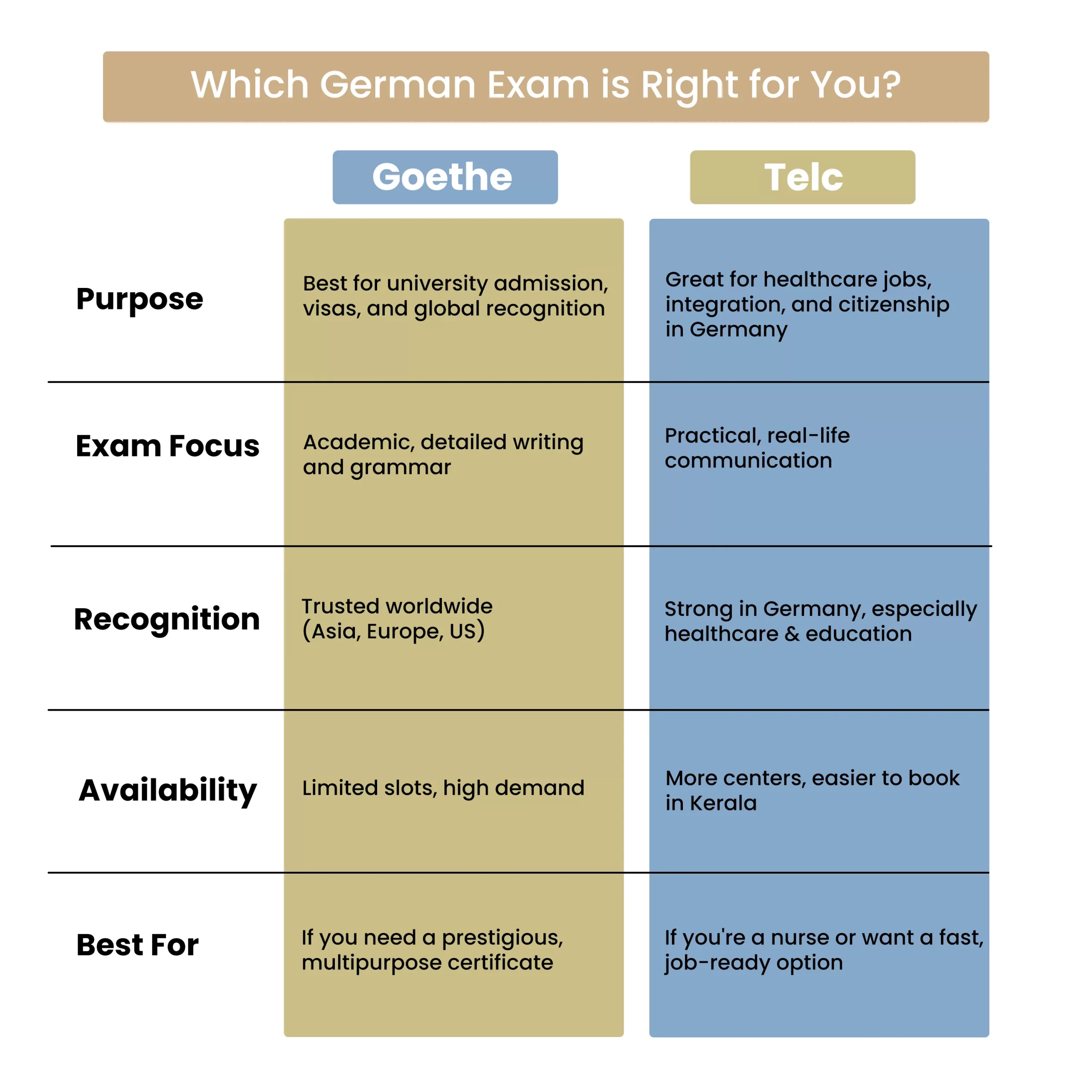
Booking slots for the Goethe exam in Kerala can be difficult due to limited availability, high demand, and a very narrow booking window. On the other hand, telc exams are less difficult to secure than Goethe, with more predictable scheduling and a less competitive booking system. Depending on your goals, choose Telc for practical, profession-specific needs or Goethe for academic and widespread recognition.
Conclusion
Investing in a German language certificate can pay off handsomely in both your career and personal life. Both Goethe and Telc certifications are valuable, but since they have different purposes, your choice should be based on your goals, budget and future plans. You should also consider your career path, target organisation, and test availability in Kerala so that you can prepare accordingly to fit your future in Germany. Good luck with your learning journey!
